
SCIN – Sophisticated Comfort Oriented Intelligent Building Envelopes
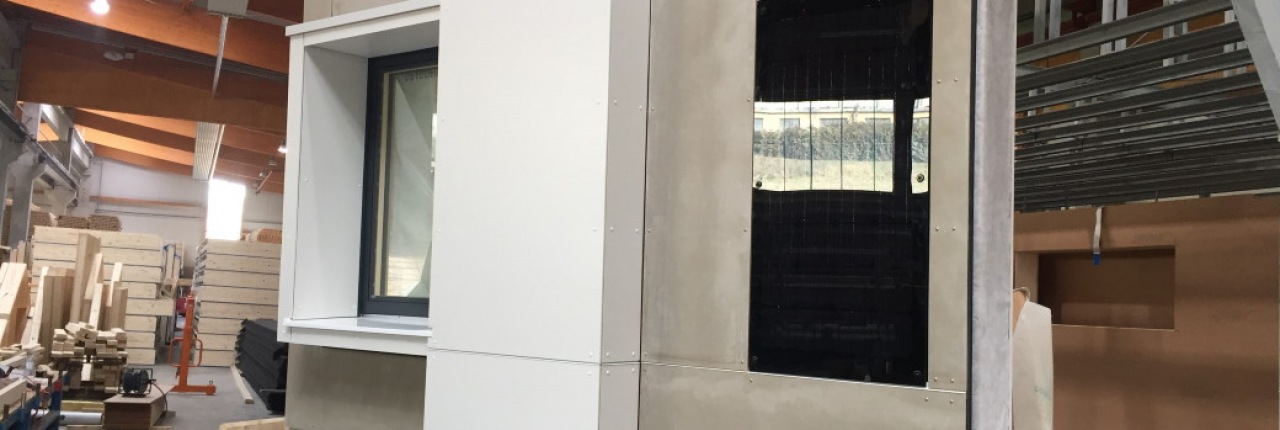
In recent years, efforts to increase energy efficiency and the share of renewable energy sources in buildings have led to a trend towards new and more complex façade systems. In the future, building envelope systems will be used multifunctionally and will convert, store or transport energy in addition to the classical functions by means of façade-integrated active components.
In the case of energy-active façade systems, however, the properties of components and systems are systematically influenced by several parameters, such as microclimate, building technology, user behaviour and indoor comfort. These dependencies cannot be shown with conventional test and simulation methods.
Previous development methods of such systems are predominantly heuristic in nature (trial and error), whereby in most cases only selective aspects or functions are evaluated. A preliminary, comprehensive test (examination), modelling, evaluation and optimisation of the overall system under all relevant interactions and real climatic as well as user-related framework conditions is currently practically impossible.
Within the framework of the SCIN project, the two research institutions AEE – Institute for Sustainable Technologies and the Salzburg University of Applied Sciences are working on corresponding numerical and measuring-related methods to fill this gap. These allow different and changing integral investigations to be carried out on energy-active facades and at the same time allow well-founded statements to be made on many aspects relevant to development (e.g. energy demand, comfort, light control, weather resistance, solar input, permanent function, dynamic behaviour).
Project coordination
AEE INTEC