
SolarHybrid – Scalable Optimization for Large-scale Advanced Renewable-Hybrid Integrated Devices

The national research project ‘SolarHybrid’ aims to improve PVT systems (hybrid photovoltaic-thermal solar energy supply systems) and reduce their costs. PVT systems have great potential, especially in combination with heat pumps, and the PVT market has grown significantly in recent years. The main areas of application for SolarHybrid are multi-storey residential buildings and industry. In […]
ReBuildStock – Portfolio Management for the Decarbonization of Large Residential Building Stocks

ReBuildStock develops a portfolio management method that supports owners of large residential building stocks in creating strategies for a rapid and socially equitable decarbonization of their portfolios. The project responds to Europe’s climate policy targets: achieving a 55% reduction in CO₂ emissions by 2030 and moving toward a climate-neutral building sector requires significantly higher renovation […]
Scientific accompanying research for the Climate and Energy Fund
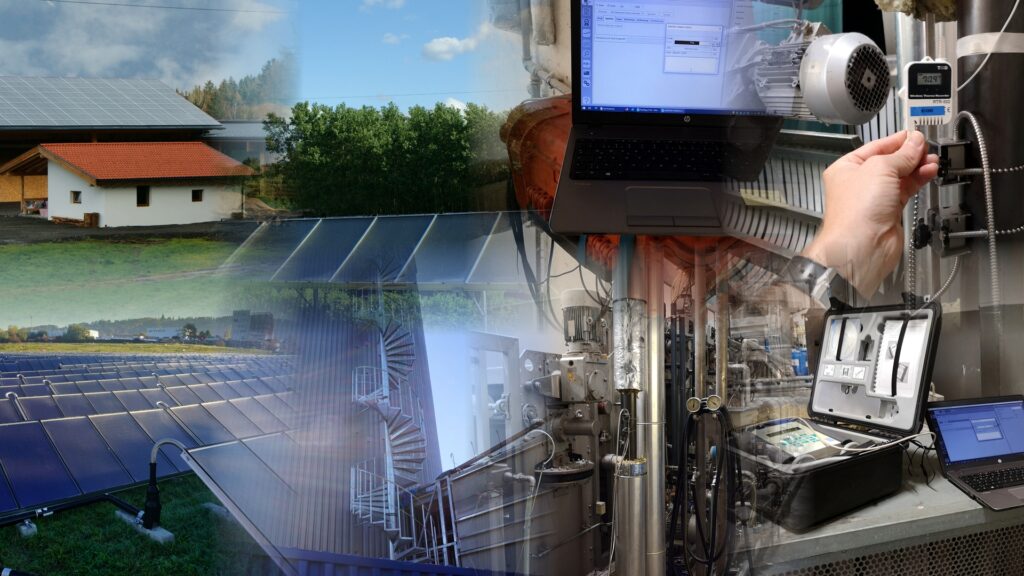
The scientific research accompanying the funding programs “Solar Thermal Energy – Large-Scale Solar Systems,” “Innovative Large-Scale Storage Systems for Electricity and Heat Energy,” and “Innovative Climate-Neutral Process Heat and Cooling in Industrial Plants” ensures that funded systems are planned according to the state of the art, implemented correctly, and operate efficiently. A key aspect is […]
TarifFlex – Price Based Demand Side Management for District Heating Grids
District heating networks are essential for the energy transition, yet currently lack pricing mechanisms to influence consumption. While dynamic tariffs are common in the electricity sector, comparable models are missing in district heating due to the absence of market prices and the complexity of generation systems. The TarifFlex project addresses this gap by developing a […]
IEA EBC Annex 94 – Validation and Verification of In-situ Building Energy Performance Measurement Techniques

This project is the Austrian contribution to the international IEA EBC Annex 94. It advances and standardises in situ measurement methods to capture real building energy performance, with a focus on the heat transfer coefficient, HTC, as a key indicator of thermal losses. AEE INTEC and TU Wien contribute methodological expertise, research infrastructure and results […]
IEA ES Task 43 – Standardized use of building mass as storage for renewable energies and grid flexibility

The building sector is a major lever for the energy transition, as a substantial share of final energy demand is still supplied by fossil fuels. Renewable energy can replace this supply, but its availability often does not match demand. Without suitable storage solutions, opportunities for decarbonisation and grid stability remain unused. Thermally activated building systems […]
SPuRM – Storage Potential of Underground Rock Mass

One of the central challenges of the energy transition is to overcome the imbalance between the generation of renewable thermal energy and its consumption. Specifically, high surplus thermal energy is generated in the summer through solar thermal systems and industrial waste heat, while the largest heat demand only occurs in the winter. To prevent the […]
Future Heat Highway – Supra-regional district heating networks for industrial waste heat integration

According to EU requirements, from 2050 onwards, all heat supplied through district heating networks must derive from renewable energy sources or industrial waste heat. Supra-regional district heating transmission pipelines can play a crucial role in reaching this objective: they connect industrial waste heat and other sustainable sources with existing and future district heating networks, industrial […]
ATESREF – Aquifer Thermal Energy Storage and re-injection using the Example of Fürstenfeld

To advance the complete decarbonization of the heating sector, bridging the temporal discrepancy between the often-fluctuating heat supply from renewable sources (e.g., solar thermal energy) and the high winter demand is essential. Aquifer Thermal Energy Storage (ATES) offers an innovative and high-performance solution for the challenge of such energy storage. In this process, excess thermal […]
CFS-Audit – Circular Food System Audit

In der Lebensmittelindustrie fallen große Mengen an nicht vermeidbaren Lebensmittelreststoffen an, die bislang nur teilweise genutzt werden. Diese vielfältigen biogenen Nebenprodukte – von Obst- und Gemüseschalen über Molke und Biertreber bis zu Backwaren- und Ölrückständen – enthalten wertvolle Inhaltsstoffe wie beispielsweise Proteine, die ein regionales verfügbares Potenzial für die Kreislaufwirtschaft darstellen. Gleichzeitig erschweren oftmals stark […]