
Future Heat Highway – Supra-regional district heating networks for industrial waste heat integration
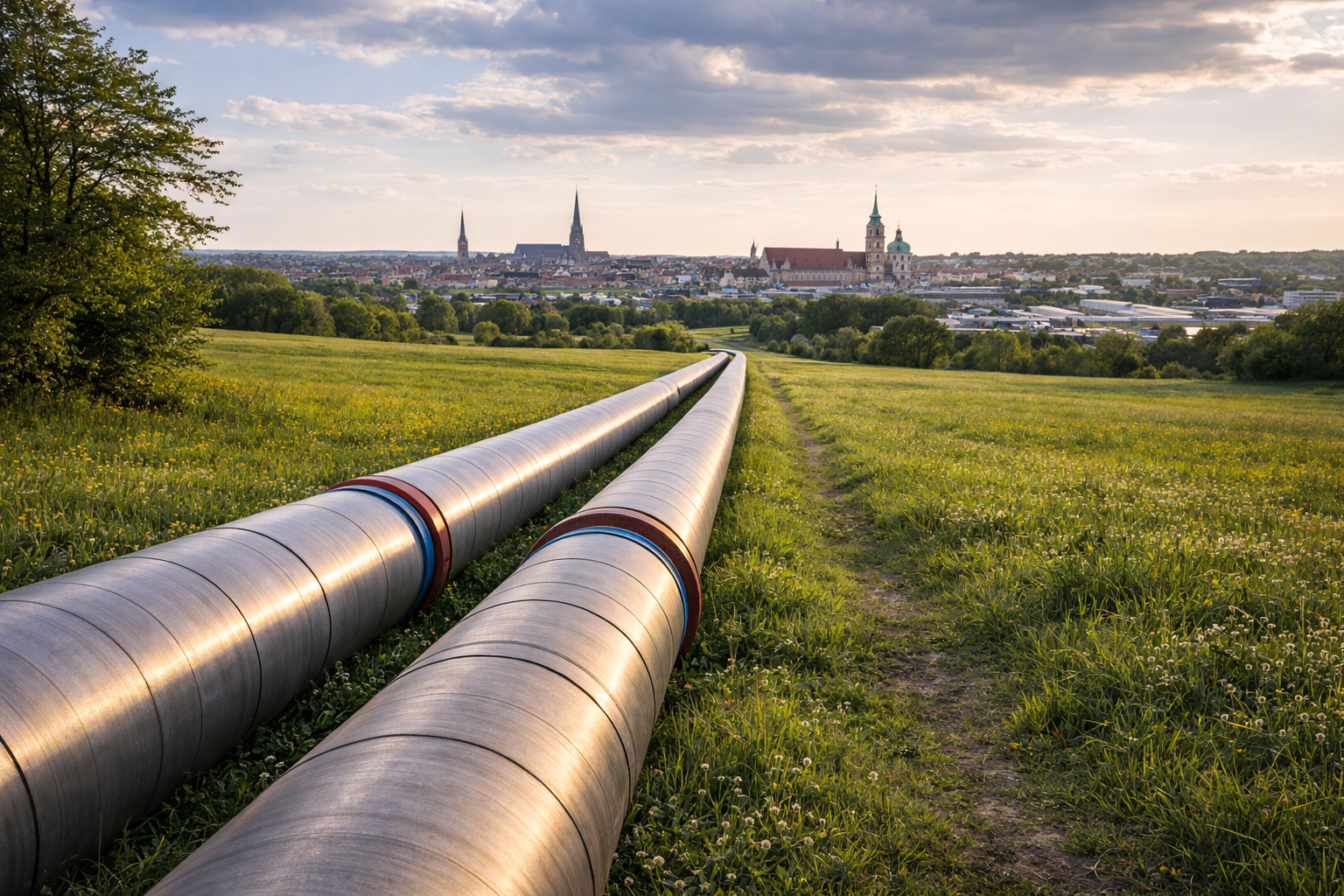
© AEE INTEC, KI generiert
According to EU requirements, from 2050 onwards, all heat supplied through district heating networks must derive from renewable energy sources or industrial waste heat. Supra-regional district heating transmission pipelines can play a crucial role in reaching this objective: they connect industrial waste heat and other sustainable sources with existing and future district heating networks, industrial process heat sinks and heat storage systems. This leads to a better balance between heat generation and consumption, enabling sustainable and efficient heat supply over large areas.
“Future Heat Highway” is a follow-up of the “Heat Highway” project led by the Energy Institute of the Johannes Kepler University in Linz and promotes the implementation of the heat-highway technology. This project is part of the climate fund program “Transformation of Industry” and is funded by the FFG. The consortium includes 28 project partners.
For the four regions Styria, the central area of Linz, the Salzkammergut and St. Pölten, roll-out plans are being developed. The primary effort in Styria is connecting Graz with substantial waste heat sources from the Mur and Mürz valleys. The work also covers the integration of storage systems, an analysis of the paper industry as a prosumer, and an assessment of future waste heat potential from the cement industry, along with industry-to-industry business models. AEE INTEC contributes expertise in modeling large-scale thermal energy storage systems and district heating networks. The technical integration and control of a seasonal storage system within the district heating network is a core element of their investigation. Another key objective is the integration of local heating networks into a supra-regional district heating network, with technical integration and control being the main areas of work.

Jakob Hütter, B.Sc.
Key activities:
System integration of large-scale thermal energy storages, modeling and simulation
Customer
Klima- und Energiefonds mit Abwicklung über die FFG
Transformation der Industrie 2024
Project coordination
Project partner
- Energieinstitut JKU Linz
- AEE – Institut für Nachhaltige Technologien
- ALLPLAN Gesellschaft m.b.H.
- Alois Haselbacher Gesellschaft m.b.H.
- Ars Electronica Linz GmbH & Co KG
- Business Upper Austria-OÖ Wirtschaftsagentur GmbH
- Ecker-Eckhofen Energie und Rohstoffe GmbH
- ENAS Energietechnik und Anlagenbau GmbH
- Energie AG Oberösterreich Erzeugung GmbH
- Energie Graz GmbH
- Fernwärme St. Pölten GmbH
- Laakirchen Papier AG
- Holcim (Österreich) GmbH
- KELAG Energie & Wärme GmbH
- Kremsmüller Anlagenbau GmbH
- LAT Nitrogen Linz GmbH
- LINZ STROM GAS WÄRME GmbH für Energiedienstleistungen und Telekommunikation
- m&m Haselbacher GmbH
- Montanuniversität Leoben Lehrstuhl für Energieverbundtechnik (EVT)
- Nahwärme Gleinstätten GmbH
- Energiesparverband Oberösterreich
- Primetals Technologies Austria GmbH
- RAG Austria AG
- Ringhofer & Partner GmbH
- Spitz GmbH
- Sappi Austria Produktions-GmbH & Co. KG
- voestalpine Stahl Donawitz GmbH
- voestalpine Stahl GmbH