
HEATbucket – Underground Heat Storage for Improving the CO2 Balance and Decentralizing the Heat Supply in Urban Areas
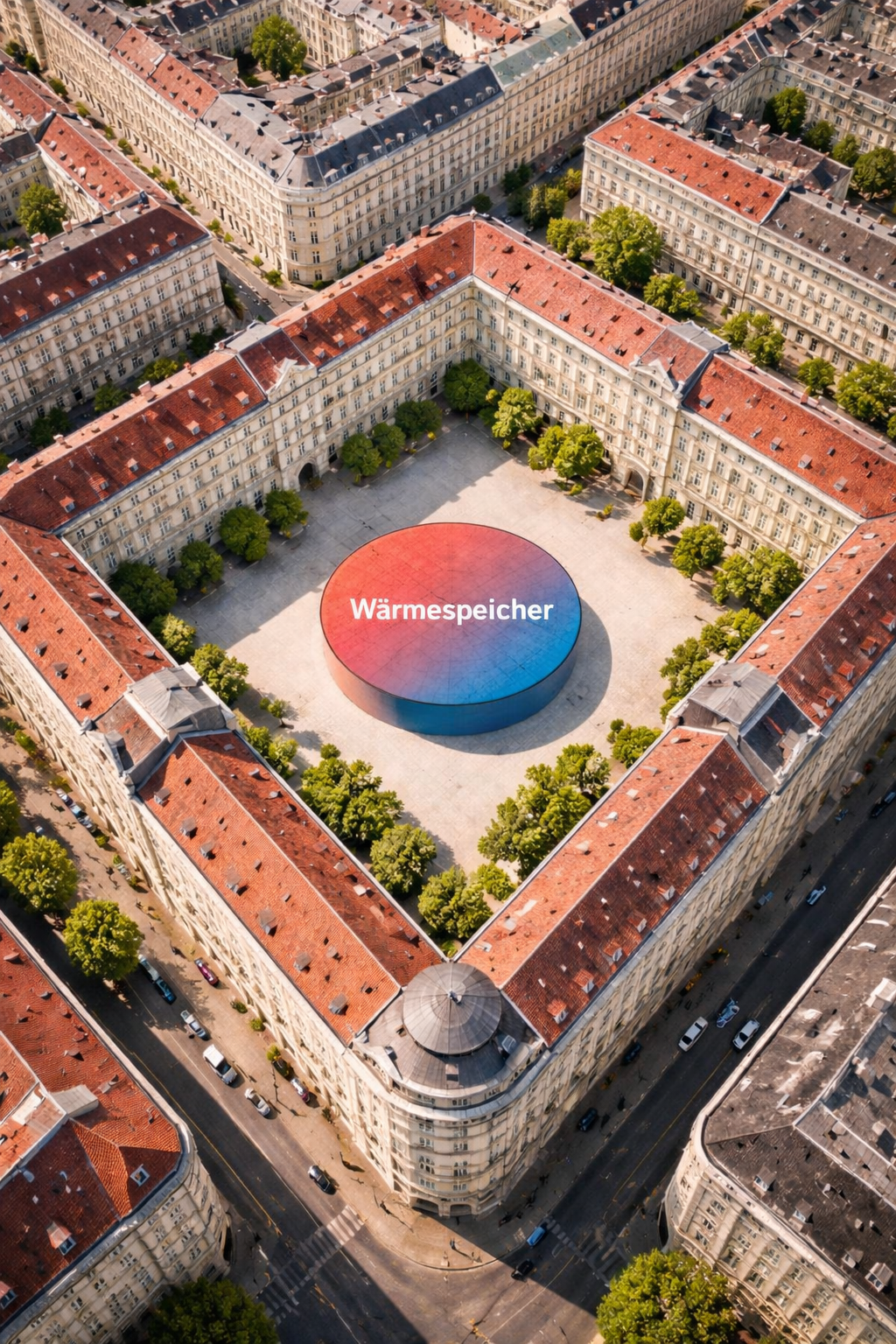
© AEE INTEC, AI generated
The global energy transition, driven by the temporal decoupling of production and demand from wind and solar power, creates a growing need for storage capacity and intensifies challenges for power grids. To complement short-term battery storage, the HEATbucket project is researching an efficient and complementary solution for urban areas: the storage of energy in the form of heat. This heat is charged either via renewable electricity using Power-to-Heat or through renewable heat sources such as solar thermal energy. To make underground heat storage practical in densely built-up urban areas, HEATbucket is developing pragmatic constructional, thermodynamic, and hydrogeological solutions. The goal is to decentralize the heat supply and improve the CO2 balance, with intensive investigation into feasibility and environmental impacts on the subsurface and groundwater.
The methodological approach includes the investigation of various storage options: both pure hot water storage and the use of the existing subsurface (unconsolidated rock and groundwater) as a storage medium. Furthermore, different construction forms – such as single large-scale tank storages, parallel small-scale storages (“battery storage”), and serial configurations – are evaluated based on available space, in order to deliver multiple solution proposals for inner-city applications. A central focus is on a comprehensive study of the influence of the storage systems on the groundwater, with the aim of developing protective measures and maintaining the groundwater temperature within an acceptable range. The technology of thermal component activation (e.g., thermal mass activation) is also examined. The investigations are carried out using laboratory experiments and numerical calculation models. The expected results are the necessary planning basis for future construction projects as well as support in creating future regulations, involving stakeholders.

Jakob Hütter, B.Sc.
Key activities:
System integration of large-scale thermal energy storages, modeling and simulation
Customer
Klima- und Energiefonds mit Abwicklung über die FFG
Technologien und Innovationen für die Klimaneutrale Stadt 2023