
GREENFOODS goes Chile – Energy efficiency and integration of renewable energy in the agro-food industry in Chile
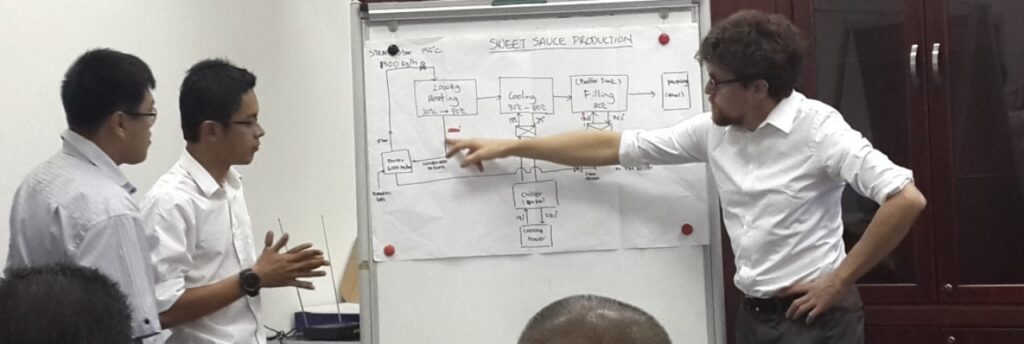
The aim of the “GREENFOODS goes Chile” courses is to increase the knowledge on energy efficiency and the integration of renewable energy of “professionals”, which are already working in the field of renewable energies or have a good engineering background in the agro-food industry in Chile. Further to transfer the specific knowledge for the integration […]
INSHIP – Integrating National Research Agendas on Solar Heat for Industrial Processes

Despite process heat is recognized as the application with highest potential among solar heating and cooling applications, Solar Heat for Industrial Processes (SHIP) still presents a modest share of about 0.3% of total installed solar thermal capacity. Key words for today’s technology development stage and for the current research demand are: In this context, INSHIP […]
IEA SHC Task 56 – Building Integrated Solar Envelope Systems for HVAC and Lighting

This Task will focus on the critical analysis, simulation, laboratory test and onsite monitoring of envelope systems entailing elements that use and/or control incident solar energy, having one or more of the following uses: Technologies are considered that account for the specificity of the intervention on residential and tertiary buildings, both new-built and retrofitted. Integration […]
Smart UP – Development of an urban district in the city of Graz towards a Reuse & Up-cycling centre

Contents and goals Target of the project is the development of an energy and resource efficient innovation district. In cooperation with the surrounding industrial and trade firms in and around the area of the existing factory building of BAN Sozialökonomische BetriebsgmbH (BAN) a Reuse & Up-cycling District will be developed. An intelligent network between the […]
Urban district heating extended – Development of flexible and decarbonized urban district heating systems
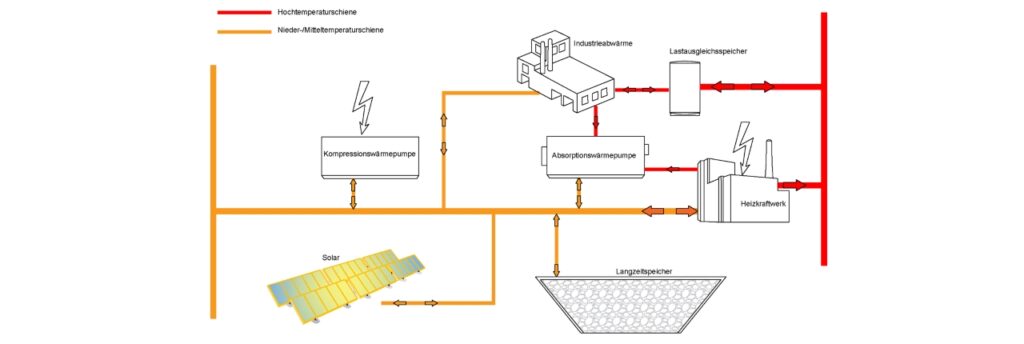
On-grid heat supply and district heating offer large potential for the reduction of CO2 emissions while offering cost-effective heat coverage, especially in urban areas. Here, district heating enables to integrate a large range of heat conversion technologies (including hybrid approaches), industrial and urban waste and thermal storage options. As a result, the use of fossil […]
REsys – Smart control strategies to improve the energy efficiency of complex hybrid energy systems

Hybrid energy systems are systems that combine different energy sources, energy distribution and storage in a compact system. The knowledge of the interdependencies and interactions between system components is the basis for the optimal design and the energy efficient operation of future and existing hybrid systems. Today empirical data from non-hybrid systems is used for […]
Energiestrategie ASFINAG
The goal of the study was the methodical identification of renewable energy potential in consideration of energy efficiency at the company ASFINAG. Based on that, a strategy for energy efficiency and renewable energy was developed. The energy and sustainability strategy is a basis for identifying future implementation projects. Possible implementations were examined and evaluated based […]
AR-HES-B – Energy storage, production and recovery of valuable substances in waste water treatment plants

The overall project goal of the AR-HES-B project is the technology rearrangement of the municipal wastewater treatment plant in order to transform the municipal wastewater treatment plant from a high energy consumer towards an optimal integrated hybrid energy provider, energy storage and resource provider in the urban environment. Via the AR-HES-B concepts the municipal sewage […]
IEA EBC Annex 67 „Energy Flexible Buildings“
In the future, the high share of renewable energy sources in electrical power and district heating grids will force the transition from a purely demand-oriented energy production (“generation on demand”) to a production-oriented demand respectively consumption (“consumption on demand”). This is also rational and necessary for the promotion of more accurate direct use of short-term […]
Development of a discussion paper
The development of a branch specific discussion paper for the food industry which examines the R&D demand for increasing the energy efficiency in the production. The branch specific trends and as a consequence thereof new and future demands will be examined. The R&D demand for energy efficiency will be presented for short, medium and long […]