
Decarb4SME+ – Building know-how for the twin transformation of manufacturing and industry – climate neutrality and digitalization

The manufacturing and industrial sectors are key pillars of the Austrian economy, employing over 700,000 people and contributing 18% to the country’s gross value added. At the same time, these sectors are responsible for nearly 30% of Austria’s greenhouse gas emissions and around one third of total energy consumption. In light of ambitious climate targets, […]
HeinrichBiCool – Climate-positive cooling and biodiversity through intensive building greening
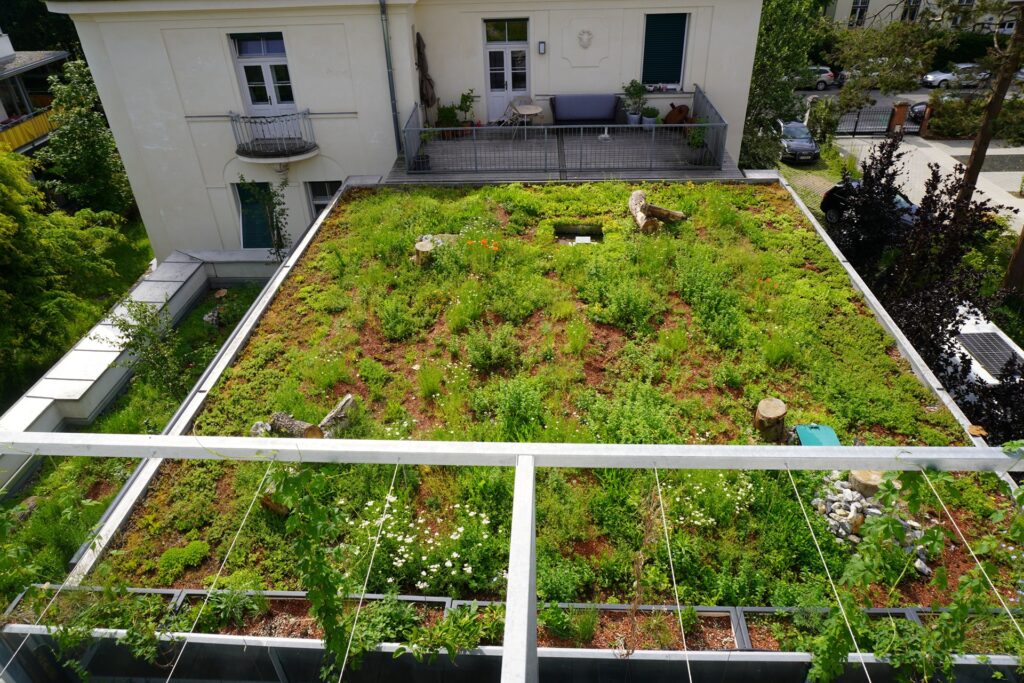
How effective is building greening in the fight against overheating in summer? The new demonstration project HeinrichBiCool is dedicated to this question – using the example of an existing building at the University of Graz at Heinrichstraße 80, used by the Faculty of Theology. The building suffers from excessive heating in the summer months, which […]
Climate-School-Life – Preparation of the climate-neutral education campus in Gratwein-Straßengel

Cities and municipalities play a crucial role at the local level in promoting sustainability and climate protection. The municipality of Gratwein-Straßengel takes this societal responsibility seriously and is actively shaping its future. With the “Klima-Schule-Leben” exploration, the first step is being taken to sustainably modernize the primary school and the entire area, while simultaneously making […]
ReVation – Renewable energy technologies and façade engineering: Achieving CO2 Neutral serial building renovation

ReVation aims to collaborate in the development and standardisation innovative solutions for low-carbon retrofitting technologies and evaluation methods for existing buildings, aligning with the sustainability commitments of China and Austria. The project will develop new approaches for scalable, prefabricated multifunctional façade renovation, advance renewable energy integration and building envelope retrofit technologies and integrated HVAC solutions […]
IEA Cities Task 2 – Data for Urban Energy Planning

Cities are central to the global energy transition: They consume 60–80 % of the energy produced worldwide and contribute significantly to CO₂ emissions. Despite their crucial role, many cities lack the necessary resources and competencies to address the complex demands of a data-driven energy transition. The IEA Cities Task 2 project, Data for Urban Energy […]
TopView – Methodology for the efficient use of remote sensing data for climate change adaptation and spatial energy planning

The TopView project addresses the challenges of urban energy and heat planning as well as adaptation to climate change. Cities and municipalities face complex tasks that conventional methods often fail to handle adequately. TopView leverages the integration of geoinformation technologies and remote sensing data to provide more precise datasets for planning processes, enabling more efficient […]
IEA DHC Annex TS9 – Digitalization of district heating and cooling systems: Increasing efficiency and optimizing performance through data integration

The IEA DHC Annex TS9 project is dedicated to researching and improving the efficiency of district heating and cooling networks through the use of digital technologies. The project pursues several key objectives: A particular focus is on the further development of “data spaces”, which play a central role in the digital infrastructure of district heating […]
Skills4DHC – Skills, Qualification and Recruitment of Professionals for the district heating and cooling (DHC) sector

Why Skills4DHC? The Skills4DHC project addresses two key challenges in the district heating and cooling (DHC) sector: the urgent need for skilled professionals and the recruitment of new talent. As Europe strives to meet its ambitious sustainable energy transition goals, the demand for a skilled workforce in the heating sector is growing. Skills4DHC bridges this […]
LösungsWege – Mobility 2023: Regional Mobility Labs & Digitalization for Mobility and Logistics Services

In Styria, over 68% of trips were made using motorized individual transport (MIT) during the period of 2013/2014. This is particularly challenging in rural areas like Eastern Styria, where navigating the first and last mile without MIT proves to be very difficult. There is a lack of inter-municipal cooperation as well as interconnected on-demand services […]
DeRiskDH – Risk mitigation in decarbonization of urban heating networks through grid temperature reductions and flexibility use

The DeRiskDH project focuses on mitigating risks in the decarbonization of urban heating networks by reducing grid temperatures and utilizing energy flexibility. Austria aims for climate neutrality by 2040, but only 48 % of current district heating comes from renewable sources. Urban areas like Vienna, Graz, Linz, and Salzburg primarily rely on natural gas-based combined […]